One of the first seating decisions you make is where the two of you will sit. It sounds small, but it decides where your wedding party sits, where their partners sit, how the room is laid out and how the photos look.
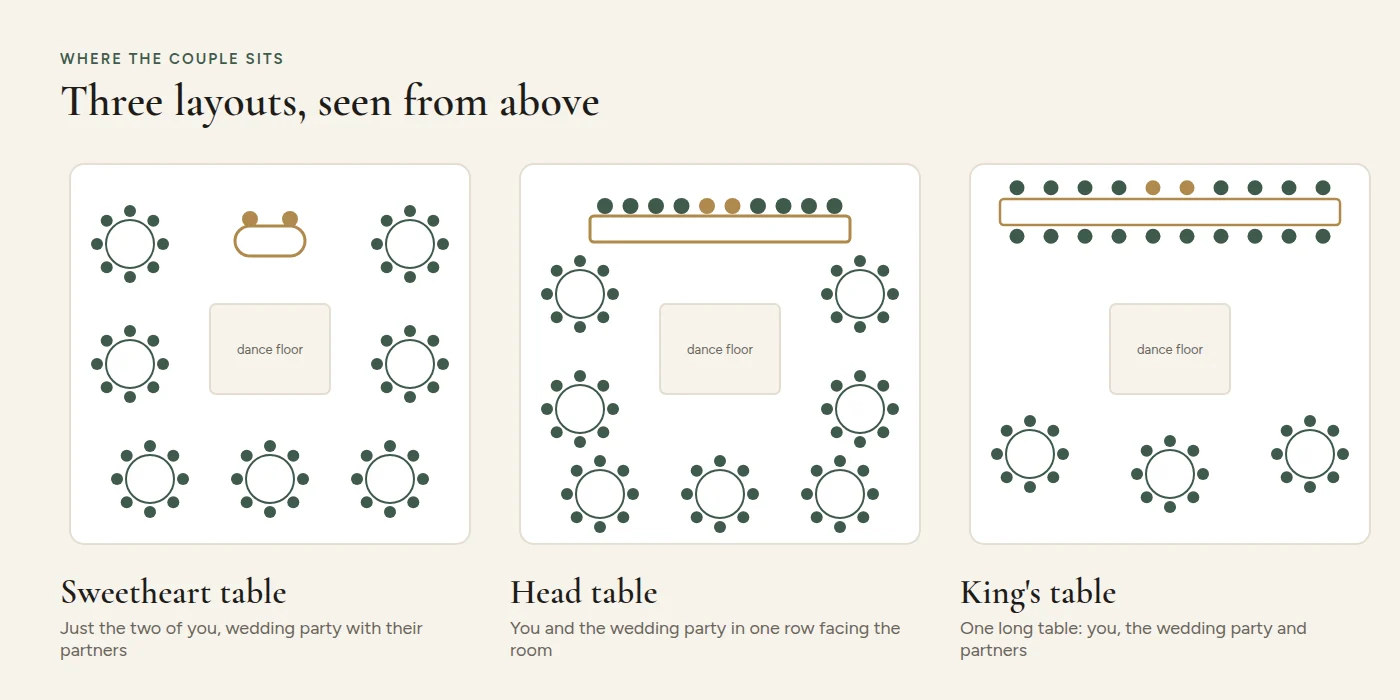
There are three main options: a sweetheart table, a head table and a king's table (also called a family-style or estate table). Here is how they compare, and who sits where with each one.
On this page
The short answer
| Sweetheart table | Head table | King's table | |
|---|---|---|---|
| Who sits there | Just the couple | Couple and wedding party | Couple, wedding party and partners |
| Size | Small round or 4 ft table | One long row facing the room | One or two long tables, both sides |
| Best for | Couples who want a moment together, large wedding parties | Traditional receptions, close wedding parties | Relaxed, family-style dinners |
| Partners of the wedding party | Sit with them at nearby tables | Usually sit elsewhere | Sit with them |
The sweetheart table
A small table for just the two of you, usually at the front of the room near the dance floor. It is typically a 30 to 48 inch round, a half-moon, or a 4 ft rectangle.
Pros
- A few quiet minutes together in a very busy day. Many couples say it was the only time they talked to each other all evening.
- Your wedding party can sit with their partners and friends.
- Guests find it easy to come over and say hello.
- It looks beautiful in photos and needs only a small amount of flowers.
Cons
- You are very visible while eating.
- You are separated from your closest friends during dinner.
Tip: Place the sweetheart table where you can see the whole room, and put the parents' and wedding party tables right around it.
The head table
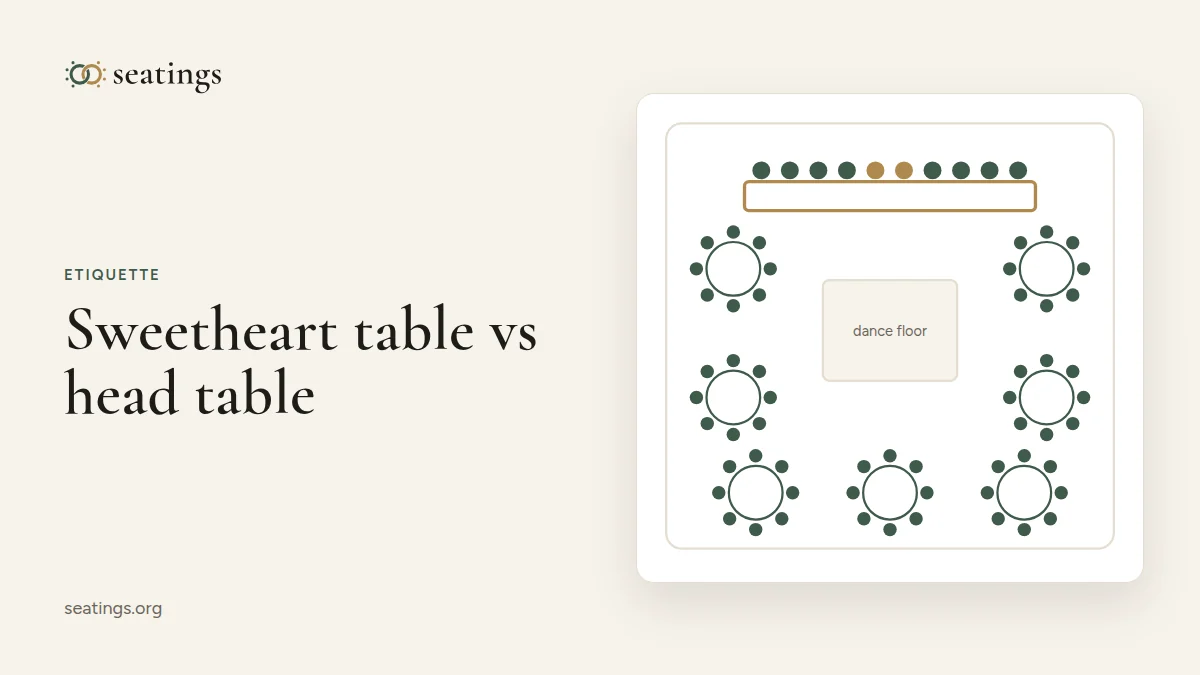
A long, straight table facing the guests, with the couple in the middle and the wedding party on either side. Usually everyone sits on one side, so no one has their back to the room.
Who sits at the head table? Most couples keep it simple:
- The couple in the centre
- The maid of honour and best man on either side of them
- The rest of the wedding party alternating outwards
Parents do not usually sit at the head table. They host their own tables close by. Some couples include both sets of parents at a longer head table, especially at smaller weddings.
Pros
- You eat with your closest people, which is a lot of fun.
- It honours the wedding party in a visible way.
Cons
- Partners of the wedding party often sit elsewhere, which can be awkward, especially for guests who do not know many people.
- A long head table takes a lot of space and flowers.
- Speaking with each other at a long row is hard.
Tip: If you choose a head table, seat the wedding party's partners at the table right in front of it, all together, so they have company.
The king's table
One long table (or two) with guests on both sides: the couple in the middle, surrounded by the wedding party and their partners, sometimes with parents. It is popular for relaxed, family-style and farm-to-table dinners.
Pros: Everyone sits with their partner, and it feels like a big family dinner. Cons: Half the table has their back to the room, and it needs a long space.
Where do parents sit?
The most common setup: each set of parents hosts a family table close to the couple, with grandparents, siblings who are not in the wedding party, and the officiant if they stay.
- Divorced parents: give each parent their own table of honour with their own family and partner, at an equal distance from you. Nobody should feel ranked.
- Small weddings: both sets of parents can share a table, which is often a lovely way to bring families together.
- Grandparents: close to the couple, but away from the speakers and with an easy path to the restrooms.
Who sits at table 1?
Table 1 is usually closest to the couple, and traditionally goes to the couple's parents (or to the family hosting the wedding). But numbers do not have to mean rank. Many couples number tables in a simple pattern around the room so waiters can find them, and give the best spots to family whatever the number.
How to decide
Ask yourselves three questions:
- Do all of our wedding party members have partners coming? If yes, a head table splits a lot of couples. A sweetheart or king's table works better.
- How big is the wedding party? More than about 10 people makes a very long head table.
- Do we want a quiet moment together? If yes, choose the sweetheart table.
There is no wrong answer. It is your dinner.
Plan it in your floor plan
Whatever you choose, draw it in your floor plan before you seat anyone, because it decides which tables are "close to the couple". In seatings you can add a round, long or head table, put it next to the dance floor, and then seat everyone around it. See how to make a wedding seating chart for the rest of the process.
Add a sweetheart or head table, seat the families around it, and print a matching chart and place cards.
Frequently asked questions
What is the difference between a sweetheart table and a head table?
A sweetheart table seats only the couple. A head table seats the couple together with their wedding party, usually in one row facing the guests.
How big is a sweetheart table?
Usually a 30 to 48 inch round table, a half-moon table, or a 4 ft rectangular table for two.
Where should the sweetheart table go?
At the front of the room with a view of all the guests, close to the dance floor, with the parents' tables and the wedding party nearby.
What can you do instead of a sweetheart table?
A head table with the wedding party, a king's table with everyone's partners, or simply sitting at a regular round table with your parents or best friends.
Do parents sit at the head table?
Traditionally no. Parents host their own tables close to the couple. At smaller weddings, including both sets of parents at the head table is also common.