Your guest list is the most important document of your whole wedding. It decides the budget, the venue, the number of invitations, the catering headcount and, at the very end, the seating chart. It is also the document most likely to cause an argument.
This guide shows you how to build it calmly: who to count, how to split it into tiers, what to do about plus ones and children, how to cut it down, and how to keep it in a format that works all the way to the seating chart.
Free template: download our wedding guest list template (Excel) or CSV. It has columns for names, side, group, plus ones, children, RSVP, meals and address, and it imports straight into the seatings app.
On this page
- Step 1: Agree on the number first
- Step 2: Write the "everyone" list
- Step 3: Sort it into tiers
- Step 4: Decide your rules, then apply them to everyone
- Step 5: Cut it down without drama
- Step 6: Keep the list in one place, in a useful format
- Track RSVPs and meals
- From guest list to seating chart
- Frequently asked questions
Step 1: Agree on the number first
Before you write a single name, agree on a rough total. Your budget and venue set it:
- Most costs are per guest. In the US the average in 2025 was about $292 per guest and 117 guests per wedding (The Knot).
- Your venue has a maximum for a seated dinner with a dance floor.
Then decide how to split it. A common and fair approach: a third for each set of parents and a third for the couple, or half and half between the two families. If one family is paying much more, talk about it openly now, not in month nine.
Step 2: Write the "everyone" list
Each of you writes down everyone you might possibly invite, without judging: family, friends, colleagues, neighbours, parents' friends. Ask both sets of parents for their lists too.
Write names the way they will appear on escort cards: first name and surname for each person, not "the Hendersons".
Step 3: Sort it into tiers
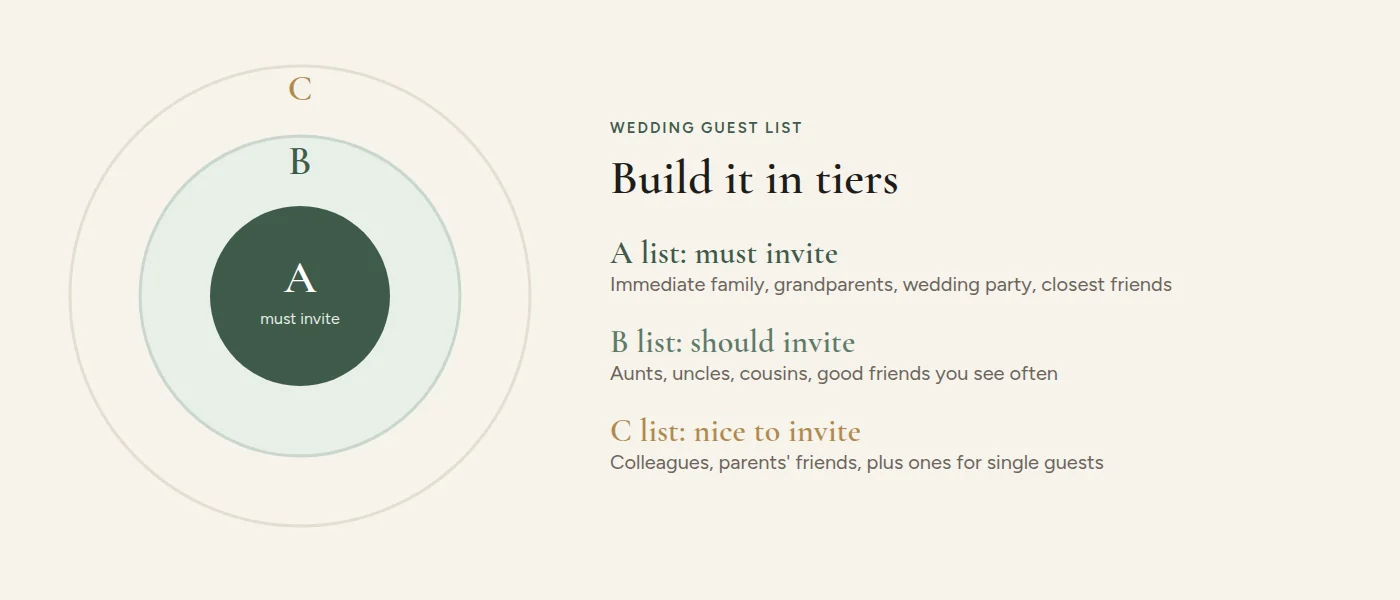
- A list: must invite. Immediate family, grandparents, the wedding party, closest friends. You would not get married without them.
- B list: should invite. Aunts, uncles, cousins, good friends you see regularly.
- C list: nice to invite. Colleagues, parents' friends, friends you have lost touch with, plus ones for guests who are not in a relationship.
If the A and B lists already exceed your number, the C list is out, and you have your answer.
Step 4: Decide your rules, then apply them to everyone
Most guest list fights are about fairness. Clear rules solve them, because they are not about any one person:
- Plus ones: married, engaged and long-term couples are invited together. Single guests get a plus one only if they will not know anyone else, or if you have the space.
- Children: all children, only family children, or an adults-only wedding. Decide once. If you invite some children, say which in the invitation's names.
- Colleagues: everyone in your team or no one, not half the office.
- "Have we seen them in the last two years?" A simple test for distant friends.
- "Would we invite them to dinner at our home?" A good test for the C list.
Step 5: Cut it down without drama
If you are still over the number:
- Remove the C list entirely.
- Apply the plus one and children rules strictly.
- Cut colleagues and "friends of parents" your parents will not miss.
- As a last resort, reduce each side's share evenly, so no one family takes the whole cut.
Expect roughly 75 to 85 percent of invited guests to come, but do not invite more people than your venue fits just because you expect some to decline. If everyone says yes, you need a chair for each of them.
Step 6: Keep the list in one place, in a useful format
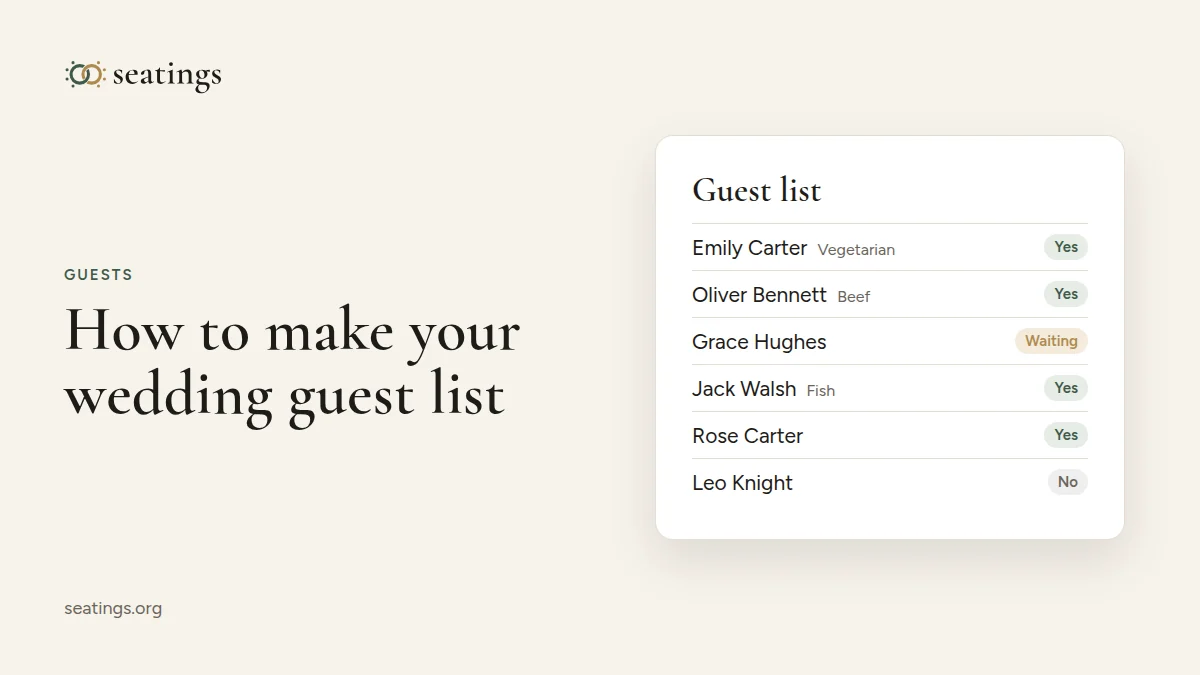
A guest list that works from the first invitation to the seating chart has one row per person and these columns:
| Column | Example | Why you need it |
|---|---|---|
| First name, Last name | Emily Carter | Invitations, cards, the chart |
| Side | Bride, Groom, Both | Balancing the list |
| Group | University friends | Seating people together |
| Plus one | yes, or a partner's name | Guests who may bring someone, couples kept together |
| Child | yes, or an age | Kids table, high chairs, meals |
| RSVP | yes, no, waiting | Headcount |
| Meal | Vegetarian | Caterer, escort cards |
| Address | Street, city | Invitations and thank-you notes |
| Notes | Wheelchair, near exit | Seating |
That is exactly the layout of our free template. List a partner either in the Plus one column or on their own row, not both. When your RSVPs come in, filter the list to the guests who said yes, you can import it into seatings and it recognises the columns automatically. See import from Excel or CSV or import from Google Sheets.
Paste or upload your guest list and start the seating chart in minutes. Couples like "Grace & Oliver Bennett" become two guests automatically.
Track RSVPs and meals
- Set an RSVP deadline three to four weeks before the wedding, earlier for destination weddings. Our invitation timeline has the dates.
- Record every reply in the same list, not in text messages and emails. Or let guests do it: with online RSVP in seatings (free) every household gets its own link, and replies, meals and allergies land straight in your guest list.
- A few days after the deadline, message everyone who has not answered. Nicely.
- Record meal choices and allergies per person. Your caterer will want a count, and your escort cards may need a small symbol for each meal.
From guest list to seating chart
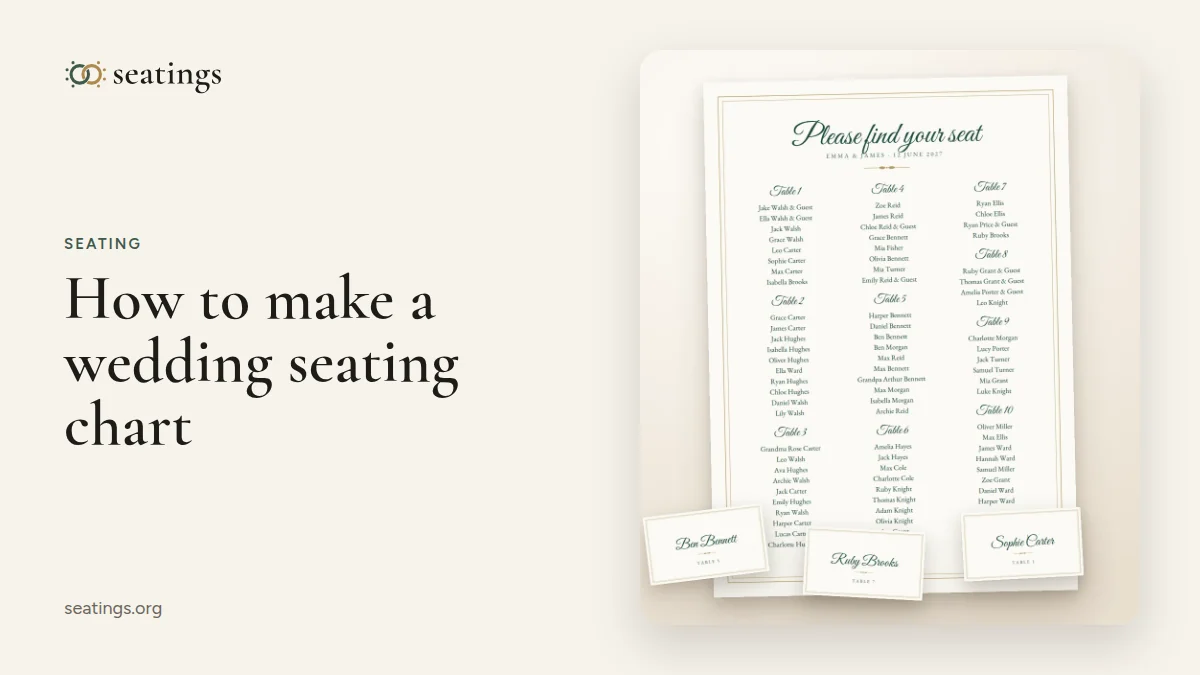
When the replies are in, your list becomes your seating chart. The groups you wrote in step 6 become the first draft of your tables. Our guide on how to make a wedding seating chart takes it from there.
Frequently asked questions
How many people should I invite to my wedding?
Start from your budget and venue. Divide the money you have for food, drink and the venue by the cost per guest, check it against the venue's seated capacity, and use the smaller number.
Who should be on the A list for a wedding?
Immediate family, grandparents, the wedding party and the friends you cannot imagine getting married without.
Do I have to give every guest a plus one?
No. Married, engaged and long-term couples should be invited together. For single guests, plus ones are a kindness, not an obligation, and they are the easiest way to reduce a long list.
How do you politely cut a wedding guest list?
Set clear rules (no plus ones for singles, no children, no colleagues) and apply them to everyone equally. People accept rules much more easily than personal decisions.
What percentage of wedding guests actually attend?
Usually around 75 to 85 percent of invited guests, lower for destination weddings and when many guests travel far. Always plan for everyone saying yes.